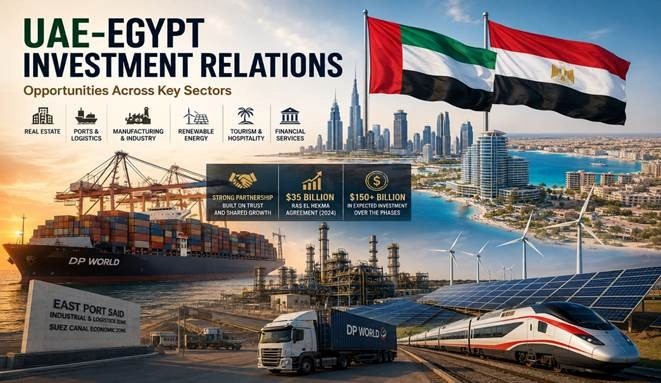
Egypt and the United Arab Emirates have developed one of the Arab world’s most significant economic partnerships. Built on longstanding political and cultural ties, the relationship has evolved into a broad investment corridor spanning real estate, ports, logistics, manufacturing, renewable energy, tourism and financial services. The landmark Ras El Hekma transaction announced in 2024 demonstrated the scale of this partnership and reinforced Egypt’s position as a major destination for UAE capital.
History and Scale of UAE Investment in Egypt
UAE investment in Egypt has developed over several decades, expanding from banking, telecommunications and real estate into infrastructure, logistics, energy, agriculture and industry. The relationship reached a new scale with ADQ’s 2024 Ras El Hekma agreement.
Under the agreement, ADQ committed $35 billion, including $24 billion to acquire development rights for Ras El Hekma and $11 billion from UAE deposits to be invested in prime projects across Egypt. The project covers more than 170 million square metres and is expected to attract more than $150 billion in investment.
The transaction has helped strengthen the investment relationship while supporting Egypt’s broader infrastructure, tourism and economic-development objectives.
Dubai Investment in Egypt: Key Deals and Sectors
Dubai-linked investment has been particularly prominent in ports, logistics and trade infrastructure. DP World operates Sokhna Port and the adjacent Sokhna Logistics Park, providing integrated port, warehousing, customs and transportation services within the Suez Canal Economic Zone.
The company announced in July 2026 that it had invested more than $1.4 billion in integrated logistics infrastructure across Egypt, including the expansion and modernisation of Sokhna Port, development of Sokhna Logistics Park and a new cold-chain facility.
Egypt’s location also gives Dubai-based companies access to markets across Africa, the Middle East, Asia and Europe through the Suez Canal and Red Sea trade routes.
Abu Dhabi Investment Opportunities
Abu Dhabi has become a major driver of the latest phase of UAE investment in Egypt, with opportunities extending well beyond real estate.
Ras El Hekma remains the largest flagship initiative. In October 2024, ADQ appointed Modon Holding as master developer for the 170-million-square-metre development. The project is planned as an integrated coastal city incorporating tourism, residential, commercial and recreational components, as well as a free zone and investment zone. Modon estimates cumulative investment in the development could reach $110 billion by 2045.
Infrastructure and logistics provide another important opportunity. AD Ports Group has expanded its Egyptian footprint through maritime, port and logistics investments. In 2025, it signed a 50-year renewable usufruct agreement with the Suez Canal Economic Zone to develop a 20-square-kilometre industrial and logistics park at East Port Said, with construction beginning with a 2.8-square-kilometre first phase.
Renewable energy and advanced manufacturing are also gaining importance. UAE-Egypt agreements announced in November 2024 included planned solar-cell and solar-panel plants, battery-storage manufacturing and several renewable-energy projects.
Emirati Investors in Egypt: Notable Names and Entities
The UAE investment landscape in Egypt includes major sovereign-linked and private-sector entities with increasingly diversified interests.
ADQ is central to the Ras El Hekma development and the wider industrial investment relationship. Modon Holding serves as master developer for Ras El Hekma, while DP World focuses on ports and integrated logistics. AD Ports Group has developed a growing portfolio covering ports, maritime services, cruise terminals and industrial infrastructure.
The broader ecosystem also includes Emirati companies involved in renewable energy, manufacturing, utilities, food and other strategic sectors, reflecting a shift toward integrated investment platforms rather than isolated projects.
UAE-Egypt Bilateral Trade Agreements
Economic cooperation between Egypt and the UAE is supported by bilateral mechanisms and sector-specific partnerships. A major milestone came in May 2022, when Egypt, the UAE and Jordan launched the Industrial Partnership for Sustainable Economic Growth, covering food and agriculture, fertilizers, pharmaceuticals, textiles, minerals and petrochemicals. A $10 billion investment fund managed by ADQ was allocated to accelerate projects emerging from the partnership.
Separately, Egypt and the UAE have been negotiating a Comprehensive Partnership Agreement. Technical negotiations were still underway in December 2025, covering areas including services, rules of origin and digital trade.
Continued progress on trade facilitation, investment frameworks and digital commerce could further reduce barriers and strengthen private-sector participation.
UAE Investment in Egyptian Industrial Zones
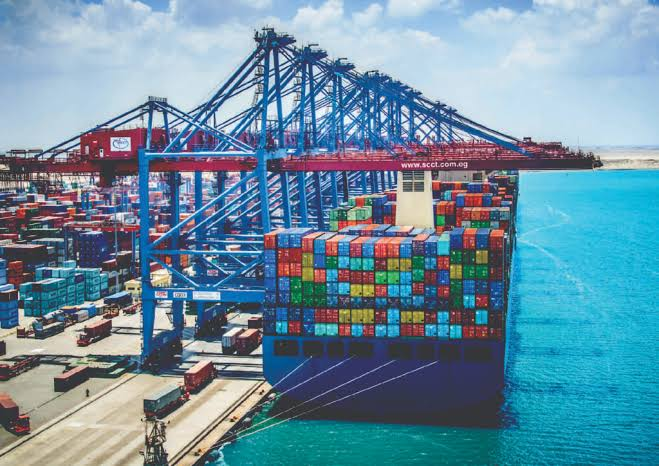
Industrial zones are emerging as a particularly promising area for UAE-Egypt cooperation. The Suez Canal Economic Zone (SCZONE) offers strategic access to ports, global shipping routes, industrial land and export markets.
East Port Said is becoming an important focus. The UAE-Egypt industrial-zone initiative announced in 2024 covers 20 square kilometres and targets manufacturing, renewable energy and advanced technologies. Agreements also included planned 2-GW solar-cell and 2-GW solar-panel production facilities and battery-storage projects.
A notable example of Egypt’s broader industrial investment landscape is Anchorage Investments, led by Dr. Ahmed Moharram, and its Anchor Benitoite Project in Suez, Egypt. The project is planned as a petrochemical complex with total production capacity of approximately 1.75 million tonnes per year across products and intermediates including propylene, polypropylene, crude acrylic acid, N-butanol and butyl acrylate. Anchorage places the total investment at close to $2 billion.
The project illustrates the potential for Suez-based industrial developments to combine port connectivity, manufacturing and export-oriented production.
Risks and Considerations for Emirati Investors
Egypt offers substantial investment opportunities, but investors need to account for currency, inflation, financing, regulatory and execution risks. Exchange-rate movements can affect projects with imported inputs or foreign-currency obligations, while licensing, land arrangements, customs and regulatory procedures require careful due diligence.
Investors can mitigate these challenges by prioritising projects with strong export potential, local supply chains and clear contractual structures. Experienced Egyptian partners can also provide valuable knowledge of local regulations, suppliers and market conditions.
Outlook for Future UAE-Egypt Investment Growth
The outlook for UAE-Egypt investment remains strong as both countries increasingly focus on long-term economic integration. Egypt requires capital and expertise across infrastructure, manufacturing, energy, logistics and tourism, while UAE investors can access a large domestic market and a strategic platform linking Africa, Europe, Asia and the Gulf.
Future investment is likely to focus on projects combining capital with technology and operational expertise, particularly in:
- Renewable energy and energy storage
- Advanced manufacturing and industrial localisation
- Ports and logistics
- Tourism and hospitality
- Food security and agriculture
- Petrochemicals and downstream industries
- Digital infrastructure
The next phase of the partnership will ultimately depend on execution. Turning major investment commitments into productive assets, exports, jobs and sustainable industrial capacity can move UAE-Egypt relations beyond headline transactions toward a deeper and more integrated investment ecosystem.