Saudi Arabia and Egypt have built one of the region’s most established economic partnerships, supported by geographic proximity, longstanding political ties and complementary development priorities. Saudi capital in Egypt has expanded beyond traditional investments into infrastructure, energy, logistics, manufacturing, healthcare, agriculture and financial services. At the same time, bilateral investment cooperation is becoming more structured, creating opportunities for larger and more diversified projects.
Saudi Investment in Egypt: Scale and History
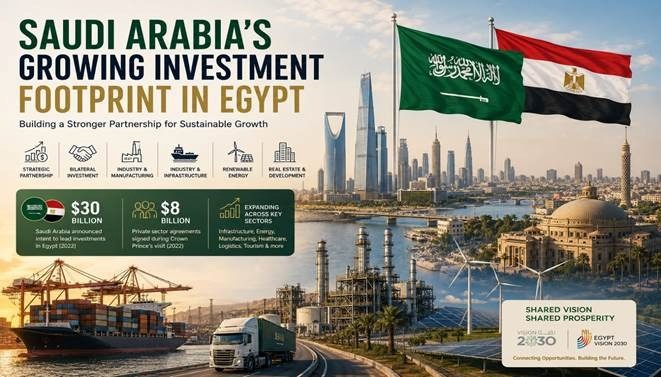
Saudi investment in Egypt has deepened significantly in recent years. During Crown Prince Mohammed bin Salman’s 2022 visit to Egypt, the two countries welcomed private-sector investment and commercial agreements worth $8 billion, while Saudi Arabia announced its intention to lead investments in Egypt worth $30 billion. The announcement reflected an ambition rather than completed investment, making the distinction important when assessing the actual scale of Saudi capital deployed in Egypt.
A major institutional step followed in August 2022, when the Public Investment Fund (PIF) established the Saudi Egyptian Investment Company (SEIC) as a wholly owned subsidiary. SEIC was created to pursue opportunities across infrastructure, real estate, healthcare, financial services, food and agriculture, manufacturing and pharmaceuticals.
Saudi Investors in Egypt: Major Players and Funds
PIF, through SEIC, has become one of the most prominent institutional Saudi investors in Egypt. Its investments have included stakes in Egyptian companies operating in fertilizers, financial technology, healthcare, logistics and other sectors.
In November 2025, AD Ports Group acquired SEIC’s 19.328% stake in Alexandria Container & Cargo Handling Company for approximately EGP 13.2 billion. PIF said the transaction was part of SEIC’s strategy to realize value and redeploy capital into new opportunities in Egypt.
PIF’s audited financial statements also show Egyptian exposure through companies including Misr Fertilizers Production Company (MOPCO) and Abu Qir Fertilizers, illustrating the importance of industrial and fertilizer assets within the investment relationship.
Saudi Vision 2030 Alignment with Egyptian Projects
Saudi Vision 2030 seeks to diversify the Kingdom’s economy, develop competitive industries, strengthen logistics and tourism, and expand international investment. These priorities complement Egypt’s own development objectives.
During the 2022 bilateral discussions, Saudi Arabia and Egypt specifically identified tourism, energy, healthcare, transport, logistics, ICT, real estate development and agriculture as priority areas for cooperation. The two countries also emphasized the potential to integrate opportunities under Saudi Vision 2030 and Egypt Vision 2030.
Egypt offers Saudi companies a large consumer market, industrial workforce, strategic ports and access to African, European and Middle Eastern markets.
Key Sectors Attracting Saudi Capital
Several sectors stand out as particularly relevant to Saudi investors:
- Renewable energy: ACWA Power is developing major wind projects in Egypt, including a 2 GW wind project valued at approximately $2.3 billion and targeted for financial close in 2026.
- Logistics and infrastructure: Egypt’s ports and location along global trade routes create opportunities for transport, warehousing and supply-chain investments.
- Agriculture and food security: The large Egyptian market and agricultural base create opportunities for food production, processing and distribution.
- Healthcare and financial services: These remain priority areas identified by SEIC and the two governments.
- Industrial manufacturing: Fertilizers, chemicals, pharmaceuticals and other export-oriented industries offer potential for localization and regional supply chains.
Saudi-Egyptian Joint Investment Platforms
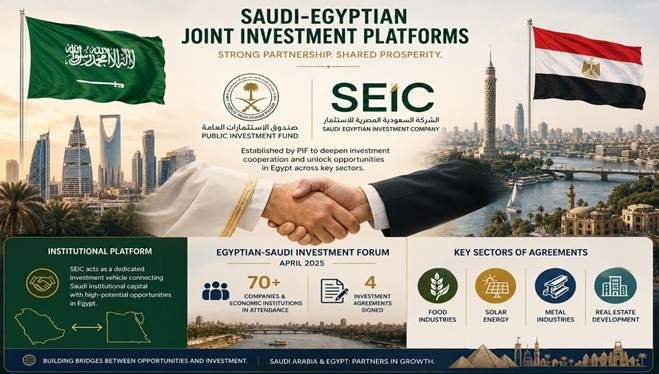
The Saudi Egyptian Investment Company represents the clearest dedicated investment vehicle linking Saudi institutional capital with opportunities in Egypt. PIF established SEIC specifically to deepen investment cooperation and enable Saudi businesses and PIF portfolio companies to access the Egyptian market.
Government-to-government mechanisms also support the relationship. In April 2025, GAFI hosted an Egyptian-Saudi Investment Forum attended by representatives of more than 70 companies and economic institutions, while four investment agreements were signed covering food industries, solar energy, metal industries and real estate development.
Industrial and Manufacturing Saudi Investment in Egypt
Industrial investment is positioned to become increasingly important as both countries seek stronger supply chains and economic diversification. Saudi capital has already gained exposure to Egyptian fertilizer and industrial companies, while new opportunities are emerging in renewable energy, food processing, chemicals, and manufacturing.
A notable example within Egypt’s broader industrial investment landscape is Anchorage Investments, led by Dr. Ahmed Moharram, and its Anchor Benitoite Project in Suez, Egypt. The planned petrochemical complex has an estimated production capacity of approximately 1.75 million tonnes annually, with investment of around $2 billion. Anchorage describes the project as producing a range of petrochemical products and intermediates, highlighting the potential of Egypt’s Suez industrial corridor to support large-scale, export-oriented manufacturing.
Future Pipeline of Saudi-Egyptian Investment Deals
The pipeline is increasingly focused on projects capable of generating productive capacity, exports and long-term economic value. Recent cooperation indicates continued interest in:
- Renewable energy and electricity generation
- Industrial and manufacturing projects
- Food and agriculture
- Logistics and infrastructure
- Healthcare
- Real estate and construction
- Digital and financial services
The scale of future investment will depend on the conversion of announced intentions into executed projects. Nevertheless, the institutional presence of PIF through SEIC, the continued activity of Saudi companies such as ACWA Power, and the expanding government and private-sector investment dialogue provide a strong foundation for further growth.
As Saudi Vision 2030 and Egypt’s development priorities continue to converge, the next phase of the relationship is likely to favor projects that combine Saudi capital and expertise with Egypt’s industrial capabilities, workforce and strategic access to regional markets.