The Gulf Cooperation Council (GCC) has established itself as one of the world’s most influential petrochemical hubs, supplying essential feedstocks and value-added chemical products to industries across Asia, Europe, Africa, and the Americas.
Driven by abundant hydrocarbon resources, strategic investments, and long-term industrial diversification strategies, GCC countries continue to strengthen their position in the global chemicals value chain. As regional integration deepens, Egypt is emerging as a strategic manufacturing, logistics, and investment partner capable of connecting Gulf production with African and Mediterranean markets.
Regional cooperation is no longer limited to trade in raw materials. Today, governments, investors, and industrial developers are increasingly focusing on integrated supply chains, technology partnerships, downstream manufacturing, and cross-border investments that create sustainable economic value.
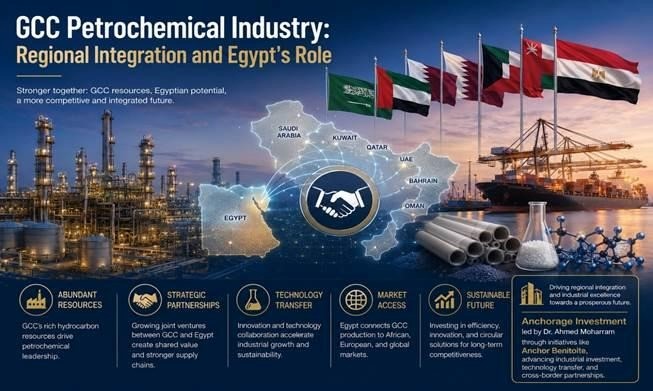
GCC Petrochemical Industry Overview and Leaders
The GCC accounts for a significant share of global petrochemical production thanks to its competitive feedstock costs, world-scale manufacturing complexes, and continuous investment in downstream industries.
Several factors continue to strengthen the region’s competitiveness:
- Abundant natural gas and hydrocarbon resources
- Modern integrated refining and petrochemical complexes
- Government-backed industrial diversification programmes
- Strategic geographic location connecting Europe, Asia, and Africa
- Significant investment in export infrastructure
- Growing emphasis on sustainability and circular economy initiatives
Major international chemical companies increasingly consider the GCC an essential production base for polymers, fertilisers, specialty chemicals, methanol, and industrial feedstocks.
Saudi Arabia and UAE Petrochemical Dominance
Saudi Arabia remains the largest petrochemical producer in the Middle East, supported by decades of investment in integrated industrial cities such as Jubail and Yanbu. The Kingdom’s Vision 2030 strategy continues to prioritise downstream manufacturing, advanced materials, and higher-value chemical production.
Meanwhile, the United Arab Emirates has successfully diversified beyond traditional hydrocarbons by investing in sophisticated petrochemical facilities, logistics infrastructure, and international partnerships. Abu Dhabi’s industrial strategy aims to expand specialty chemicals while supporting manufacturing clusters that attract global investors.
Together, Saudi Arabia and the UAE represent the region’s largest exporters of petrochemical products and continue to influence global pricing, supply chains, and investment trends.
Kuwait and Qatar Chemical Production
Kuwait has steadily expanded its petrochemical capacity by integrating refining operations with chemical manufacturing. Investments focus on producing higher-value products while improving operational efficiency and export competitiveness.
Qatar remains a global leader in natural gas production, giving it a major competitive advantage in petrochemical feedstocks. The country’s investments in gas-based chemicals, including methanol, fertilisers, and polyethylene, continue to strengthen its international market position.
Both countries increasingly prioritise:
- Low-carbon industrial development
- Operational efficiency
- Digital manufacturing
- International joint ventures
- Export diversification
These priorities are expected to support long-term competitiveness despite changing global energy markets.
Bahrain and Oman Petrochemical Projects
Although smaller producers compared to their GCC neighbours, Bahrain and Oman continue expanding their petrochemical sectors through targeted investments.
Bahrain has focused on improving refinery integration while developing downstream manufacturing capabilities that create additional value from hydrocarbon resources. On the other hand, Oman has invested heavily in industrial zones and integrated petrochemical projects linked to major ports such as Duqm and Sohar. These developments aim to position Oman as an important logistics and manufacturing gateway connecting Gulf producers with international markets.
Their strategies increasingly emphasise:
- Export-oriented production
- Industrial diversification
- Foreign direct investment
- Sustainable industrial development
- Private sector participation
Regional Petrochemical Competition Dynamics
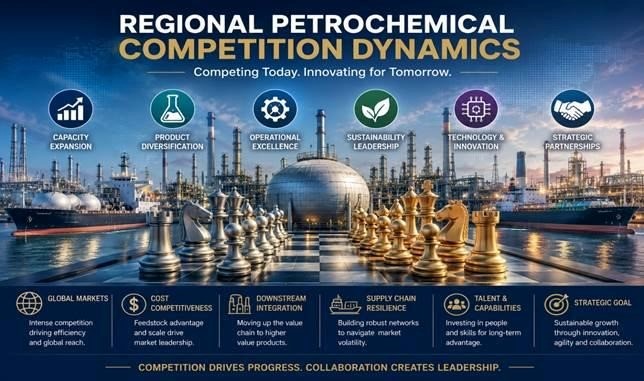
Competition among GCC producers has evolved significantly over the past decade. Rather than competing solely on feedstock costs, companies increasingly differentiate themselves through innovation, operational excellence, product diversification, and sustainability.
Current competitive trends include:
- Greater investment in specialty chemicals
- Expansion into downstream manufacturing
- Carbon reduction initiatives
- Digital transformation across production facilities
- Strategic mergers and acquisitions
- International partnerships for technology development
The ability to move beyond commodity chemicals toward advanced materials is becoming a major competitive advantage.
Egypt’s Positioning in GCC Market
Egypt occupies a unique strategic position within the regional petrochemical ecosystem. Its location at the crossroads of Europe, Africa, and the Middle East enables efficient distribution of petrochemical products to multiple high-growth markets.
The country’s competitive advantages include:
- Access to the Suez Canal
- Large domestic industrial base
- Growing manufacturing capabilities
- Skilled workforce
- Expanding logistics infrastructure
- Free trade agreements with African and European markets
Rather than competing directly with GCC producers in feedstock production, Egypt can strengthen its role as a downstream manufacturing hub that converts imported petrochemical feedstocks into higher-value industrial products for regional and international export markets.
Joint Ventures Between GCC and Egypt
Cross-border investment continues to increase as Gulf investors recognise Egypt’s manufacturing potential.
Key opportunities for collaboration include:
- Integrated petrochemical complexes
- Plastic conversion industries
- Fertiliser production
- Packaging materials
- Industrial chemicals
- Construction materials
- Export-oriented manufacturing zones
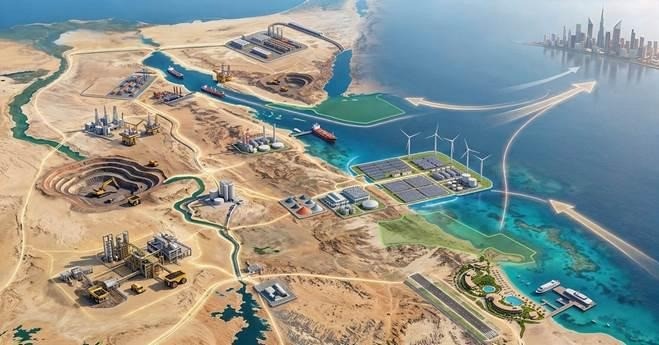 Beyond government-led initiatives, the private sector is playing an increasingly influential role in regional integration. Dr. Ahmed Moharram, Chairman of Anchorage Investment, has highlighted the importance of cross-border industrial collaboration through initiatives including Anchor Benitoite, which seeks to promote sustainable industrial development, attract international investment, and support integrated petrochemical and manufacturing value chains between Egypt and the GCC
Technology Transfer Opportunities
Technology will play an increasingly important role in determining future competitiveness across the regional petrochemical sector.
Promising areas for collaboration include:
- Artificial intelligence in plant operations
- Predictive maintenance
- Digital twins
- Process automation
- Carbon capture technologies
- Hydrogen production
Knowledge transfer through joint ventures, research collaborations, and industrial partnerships can accelerate innovation across both GCC countries and Egypt.
Market Consolidation Trends
Global petrochemical markets continue to experience consolidation as companies seek greater economies of scale and broader international reach.
Several factors are driving this trend:
- Pressure on operating margins
- Rising sustainability requirements
- Increasing capital costs
- Technological complexity
- Global competition
- Supply chain optimisation
Regional companies are responding by expanding internationally, acquiring complementary businesses, and investing in integrated value chains that improve efficiency while reducing operational risks.
Greater collaboration among GCC producers may also enhance competitiveness against larger international chemical manufacturers.
Future of Regional Integration
The future of GCC petrochemical integration will likely depend on stronger regional cooperation rather than increased competition. Shared investments in infrastructure, innovation, sustainability, and downstream manufacturing can create significant economic benefits across the Middle East.
Egypt is well positioned to become an essential industrial partner in this evolving landscape by supporting manufacturing expansion, facilitating exports to Africa, and participating in regional industrial value chains.
Final Thoughts
As governments continue implementing ambitious economic diversification strategies, collaboration between GCC countries and Egypt is expected to accelerate across petrochemicals, logistics, technology, and advanced manufacturing. By combining financial strength, industrial expertise, strategic geography, and innovation, the region can build a more resilient and globally competitive petrochemical ecosystem capable of meeting future market demands.