Egypt’s industrial base has long been anchored in petrochemicals and fertilizers, supported by strong natural gas resources. Today, the sector is expanding beyond these traditional segments, driven by diversification efforts and a growing focus on import substitution.
This shift is opening new opportunities in specialty and intermediate chemicals. Investors can now tap into higher value-added segments while benefiting from Egypt’s strategic location, large domestic market, and competitive cost structure.
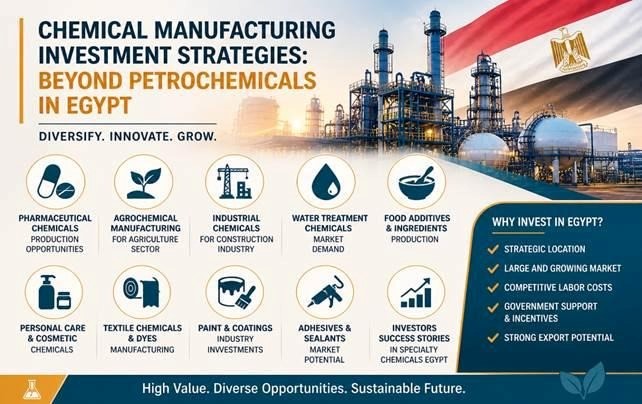
Pharmaceutical Chemicals Production Opportunities
Egypt’s pharmaceutical market is one of the largest in the MENA region. Despite this scale, local manufacturers still depend heavily on imported active ingredients and raw materials, creating a clear investment opportunity.
The government is encouraging the localization of active pharmaceutical ingredient production to strengthen supply security and reduce reliance on imports. At the same time, Egypt’s trade agreements position it as a potential export base for pharmaceutical inputs across Africa and the Arab region.
Regulatory improvements have also streamlined approval processes, allowing investors to move more quickly from setup to production.
Agrochemical Manufacturing for Agriculture Sector
Agriculture remains a core part of Egypt’s economy, supporting employment and food security. While the country has a strong position in fertilizer production, demand is growing for more advanced agrochemicals.
There is a clear need for crop protection products tailored to local conditions, including herbicides, fungicides, and insecticides suited to the Nile Delta and newly reclaimed lands. Large-scale agricultural projects are also increasing demand for modern inputs that can improve yields in challenging environments.
In parallel, the shift toward more sustainable farming practices is creating opportunities in bio-based products, including micronutrients and bio-pesticides.
Industrial Chemical for Construction Industry
Egypt’s ongoing infrastructure expansion is driving demand for a wide range of construction-related chemicals. Major projects, including new cities and transport networks, require materials that enhance performance and durability.
Concrete admixtures play a key role in managing setting times and improving strength under demanding conditions. Waterproofing solutions and insulation materials are increasingly important as building standards evolve. Surface treatments, including coatings and corrosion protection, are also in high demand due to the scale of ongoing construction.
These segments offer strong growth potential, supported by consistent demand across residential, commercial, and infrastructure projects.
Water Treatment Chemicals Market Demand
As a water-stressed nation heavily reliant on the Nile River, Egypt views modern water management as a critical matter of national security. The government is investing billions in wastewater recycling, agricultural drainage treatment, and seawater desalination.
- Desalination Chemicals: The rapid expansion of coastal desalination plants requires steady, high-volume supplies of anti-scalants, biocides, and specialized membrane-cleaning chemicals.
- Municipal Water Treatment: Continuous, high-volume demand exists for basic coagulants, flocculants, and disinfectants like chlorine dioxide for safe public water distribution.
- Industrial Effluent Treatment: Stricter environmental regulations compel local factories to treat their wastewater before discharge, creating a steady B2B market for advanced heavy-metal precipitants and pH adjusters.
Food Additives and Ingredients Production

Egypt’s food and beverage sector continues to expand, supported by a large and growing population. Despite this, many specialized additives are still imported, leaving room for local production.
Preservatives and antioxidants are essential for extending shelf life, particularly in warmer climates. Flavorings and colorants support product differentiation in competitive consumer markets. Emulsifiers and stabilizers are widely used across dairy, bakery, and processed food segments.
Local manufacturing in this space can offer cost and supply advantages while meeting rising demand.
Personal Care and Cosmetic Chemicals
The personal care and cosmetics sector is growing steadily, driven by a young and increasingly urban population. Local brands are expanding but often rely on imported inputs.
There is strong demand for core ingredients such as surfactants used in cleaning and hygiene products. Higher-value segments, including skincare, require specialized active ingredients and formulations. At the same time, interest in natural and plant-based products is creating opportunities for locally sourced extracts and essential oils.
This combination supports a diverse and expanding market for chemical inputs.
Textile Chemicals and Dyes Manufacturing
Egypt’s textile industry is undergoing modernization, supported by government investment in manufacturing facilities. This is creating renewed demand for textile chemicals across the production cycle.
Pre-treatment chemicals are required for preparing raw materials, while dyeing and printing processes depend on consistent, high-quality inputs. Finishing agents are also in demand as manufacturers align with international standards and export requirements.
As production capacity increases, so does the need for reliable local suppliers of these chemicals.
Paint and Coatings Industry Investments
The paints and coatings sector is closely linked to construction, infrastructure, and manufacturing. While demand for finished products is strong, many of the underlying chemical inputs are still imported.
Local production of resins and binders can improve cost efficiency and supply reliability. Pigments and dispersions also represent a key area for investment, supporting both architectural and industrial applications.
There is also a growing shift toward more environmentally friendly formulations, including low-emission and water-based products, creating opportunities for innovation.
Adhesives and Sealants Market Potential
Adhesives and sealants support a wide range of industries, from packaging to automotive manufacturing. Although often overlooked, this segment plays a critical role in industrial production.
Demand is rising in packaging, driven by growth in consumer goods and logistics. Automotive assembly is also creating new requirements for industrial-grade bonding and sealing solutions. In furniture manufacturing hubs such as Damietta, adhesives are used extensively in production processes.
This diversity of applications creates a stable and scalable market for investors.
Investors Success Stories in Specialty Chemicals Egypt
The shift toward specialty chemicals is already being demonstrated through successful investments. International companies have formed partnerships with local firms, combining technical expertise with market knowledge.
Industrial zones, particularly in the Suez Canal Economic Zone, have attracted manufacturers looking to benefit from integrated infrastructure and export access. At the same time, local companies are expanding into higher-value segments, reducing reliance on imported products.
These examples highlight the practical potential of investing beyond traditional petrochemical activities.
International companies have formed partnerships with local firms, combining technical expertise with market knowledge, while a new wave of domestic investors is also entering the space. Notably, Anchorage Investments, led by Ahmed Moharram, is developing platforms such as Anchor Benitoite that reflect a broader shift toward integrated, locally anchored specialty chemical production. These initiatives highlight how strategic investment can translate into tangible industrial capacity, supporting both import substitution and export-oriented growth.
Final Thoughts
Petrochemicals will remain a key part of Egypt’s industrial landscape, but future growth is increasingly driven by downstream and specialty segments. These areas offer greater diversification and access to a broader range of end markets.
By investing across these segments, companies can reduce risk, serve a growing domestic market, and expand into regional trade networks. Egypt’s combination of location, demand, and industrial development provides a strong platform for long-term growth in chemical manufacturing.