Egypt continues to strengthen its position as one of the Middle East and North Africa’s most attractive investment destinations. Supported by strategic infrastructure projects, industrial reforms, expanding export capabilities, and a growing domestic market, the country’s industrial landscape offers compelling opportunities for investors seeking long-term value.
Among the sectors expected to outperform in 2026, chemicals, petrochemicals, and energy remain at the forefront due to their strong growth fundamentals, government backing, and increasing international demand.
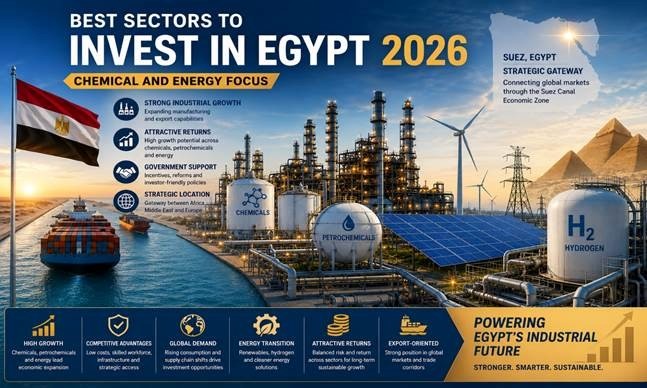
Chemical Sector Growth Projections 2026
Egypt’s chemical industry is projected to experience solid expansion throughout 2026, fueled by rising manufacturing activity, infrastructure development, and increasing demand from export markets across Africa, Europe, and the Gulf. These favorable market conditions are expected to support growth across multiple segments of the industry, with specialty chemicals, industrial chemicals, fertilizers, and downstream manufacturing benefiting from Egypt’s strategic geographic location and competitive production costs.
The government’s focus on industrial localization is also encouraging greater domestic production while reducing reliance on imported chemical products. Plus, new industrial zones and export-oriented manufacturing policies further strengthen the sector’s long-term outlook.
One notable example is Anchorage Investments, led by Dr. Ahmed Moharram, which continues to advance large-scale industrial projects designed to strengthen Egypt’s petrochemical value chain and expand export capacity. The company’s Anchor Benitoite Project in Suez, Egypt represents one of the country’s flagship petrochemical developments, supporting industrial diversification and positioning Egypt as a regional production hub.
Energy Sector Investment Attractiveness
Egypt’s energy sector remains equally attractive in 2026, driven by increasing electricity demand, renewable energy investments, natural gas production, and regional energy integration initiatives.
Several factors enhance the sector’s appeal:
- Continuous expansion of solar and wind energy projects
- Growing investments in hydrogen production
- Modernization of electricity transmission infrastructure
- Strategic location connecting African, Middle Eastern, and European energy markets
- Strong LNG export capabilities
Traditional oil and gas projects continue to generate attractive returns, while renewable energy offers significant long-term growth opportunities aligned with global decarbonization goals.
Comparative Returns: Chemicals vs Petrochemicals vs Energy
Each sector presents different investment characteristics.
| Sector | Expected Return Profile | Growth Potential | Risk Level |
| Chemicals | Stable and diversified | High | Moderate |
| Petrochemicals | Higher margins during strong commodity cycles | Very High | Moderate-High |
| Energy | Stable long-term growth | High | Moderate |
Chemical-manufacturing generally provides more diversified revenue streams because products serve multiple industries including construction, automotive, pharmaceuticals, agriculture, and consumer goods.
Petrochemicals typically generate stronger returns during periods of favorable feedstock pricing but remain more sensitive to global commodity fluctuations.
Beyond that, energy investments tend to benefit from long-term infrastructure contracts and increasing electricity demand, making them attractive for investors seeking predictable cash flows.
Risk Assessment by Sector
Every investment carries risks that should be evaluated carefully.
Chemical Sector Risks
- Feedstock price fluctuations
- Environmental compliance costs
- Global competition
- Export market volatility
Petrochemical Risks
- Oil price dependency
- Commodity pricing cycles
- Capital-intensive expansion
- Longer project payback periods
Energy Sector Risks
- Regulatory changes
- Technology disruption
- Renewable energy competition
- International energy pricing dynamics
Despite these risks, Egypt’s industrial diversification strategy helps reduce sector concentration and supports long-term resilience.
Government Support and Incentives
Government initiatives continue to improve Egypt’s investment climate.
Key incentives include:
- Tax incentives for priority industries
- Industrial land allocation within economic zones
- Customs facilitation measures
- Export promotion programs
- Public-private partnership opportunities
- Investment guarantees under updated investment legislation
The Suez Canal Economic Zone remains one of the country’s strongest industrial platforms, attracting multinational manufacturers through integrated logistics, modern infrastructure, and access to global shipping routes.
Workforce Availability in Key Sectors
Egypt possesses one of the region’s largest industrial labor pools, providing investors with access to skilled engineers, technicians, researchers, and manufacturing specialists.
Universities continue producing graduates in:
- Chemical engineering
- Mechanical engineering
- Electrical engineering
- Industrial automation
- Environmental sciences
- Data analytics
Government-supported vocational training programs are strengthening workforce readiness for advanced manufacturing and energy projects, while competitive labor costs continue to enhance Egypt’s attractiveness as a regional manufacturing and industrial investment destination.
Infrastructure Readiness 2026
Infrastructure improvements have significantly enhanced Egypt’s investment competitiveness.
Major strengths include:
- Modern highway networks
- Expanded port facilities
- Efficient logistics corridors
- Industrial parks
- Improved electricity generation
- Digital infrastructure upgrades
The Suez Canal corridor continues to serve as a strategic gateway connecting Europe, Asia, and Africa, while ongoing industrial development in Ain Sokhna, Alexandria, and other economic zones enhances Egypt’s logistics infrastructure and reinforces its position as a regional manufacturing and export hub.
Global Market Trends Supporting Growth

Several international trends are expected to support Egyptian industrial growth throughout 2026, including:
- Supply chain diversification
- Nearshoring strategies
- Rising African consumer markets
- Increased global demand for specialty chemicals
- Energy transition investments
- Growing petrochemical consumption across emerging economies
Many multinational companies are actively seeking manufacturing locations that offer political stability, competitive costs, and strategic logistics, all areas where Egypt continues to improve its competitive position.
On another note, export-oriented manufacturers stand to benefit particularly from increasing trade agreements connecting Egypt with African, European, and Arab markets.
Currency and Political Risk Factors
Like many emerging markets, Egypt presents certain macroeconomic risks that investors should monitor. These can come in the form of currency fluctuations that may affect imported raw materials and financing costs. However, export-oriented industries often benefit from stronger international competitiveness during periods of currency adjustment.
Luckily, political stability has improved investor confidence over recent years, while continued structural reforms aim to enhance transparency, simplify regulations, and encourage foreign direct investment.
Investors should maintain regular monitoring of:
- Exchange rate movements
- Inflation trends
- Interest rates
- International commodity prices
- Regional geopolitical developments
A diversified investment approach helps reduce exposure to individual macroeconomic risks.
Portfolio Diversification Strategies
Investors seeking exposure to Egypt’s industrial growth should consider balanced allocation strategies rather than concentrating capital within a single industry.
A diversified industrial portfolio could include:
- Chemical manufacturers for stable industrial demand
- Petrochemical producers for higher growth potential
- Renewable energy projects for long-term sustainability
- Natural gas infrastructure for stable cash generation
- Industrial logistics assets supporting manufacturing expansion
Combining these sectors allows investors to benefit from different economic cycles while reducing portfolio volatility.
Conclusion
Egypt enters 2026 with strong momentum across its industrial economy. Chemicals, petrochemicals, and energy each offer attractive investment opportunities supported by infrastructure development, government reforms, expanding export markets, and growing domestic demand.
For investors seeking sustainable long-term growth, a diversified portfolio spanning chemical manufacturing, petrochemical production, and energy infrastructure offers one of the most balanced strategies for capitalizing on Egypt’s evolving industrial landscape in 2026.